Custom development for a client portal: $15,000 and two to three months of back-and-forth with a dev team. Building the same thing in an AI-assisted tool: anywhere from an afternoon to a few days, depending on which tool you pick, and whether you write code.
That "depending" is where the Lovable vs Windsurf decision lives. Both tools use AI to speed up building, but they start from completely different assumptions about who's doing the building and how much infrastructure they want to manage. Windsurf assumes you already have a terminal open. Lovable assumes you might never need one.
This isn't a question of which tool is better in the abstract. It's a question of which one matches the way you actually work.
What Windsurf Is
Windsurf is an AI-native integrated development environment built for intermediate to advanced developers who want AI-first assistance throughout their coding workflow.
At its core sits Cascade, a multi-step AI assistant that understands entire codebases, not just the file you're looking at. According to Windsurf's documentation, Cascade analyzes project structure and dependencies across files, performs coordinated multi-file edits, executes terminal commands autonomously, and creates checkpoint-based restore points for safe experimentation.
When we say "developer" here, we mean someone comfortable in a terminal, working with version control, and managing their own deployment. Windsurf doesn't provision databases, set up hosting, or handle authentication for you. It makes everything you already do faster. In practice, Windsurf positions Cascade for codebase-wide work like refactors and coordinated multi-file changes, plus iterative build/test loops via terminal automation (see Cascade workflows).
The tradeoff is clear: you get full control over architecture, deployment, and infrastructure decisions. You also carry full responsibility for them.
Windsurf's Pro plan starts at $15 per month with 500 prompt credits. A free tier offers 25 prompt credits for evaluation. For teams, Teams pricing scales to $30 per user per month. Check Windsurf's pricing page for current details.
What Lovable Is
Lovable is an AI app builder that turns conversation into deployed, full-stack applications: no IDE, no terminal, no local setup.
We built Lovable on a specific conviction: the gap between having an idea and having a working product shouldn't require learning to code or handing your vision to someone else. Where Windsurf accelerates a developer's existing process, Lovable replaces the need for that process entirely. You describe what you want in plain language, and you get frontend UI, backend logic, database schemas, authentication, and deployment infrastructure in one step—as a real, exportable codebase built on industry-standard technologies. Code ownership and portability are built in from the start (see our deployment docs), and every project is a standard Vite + React application.
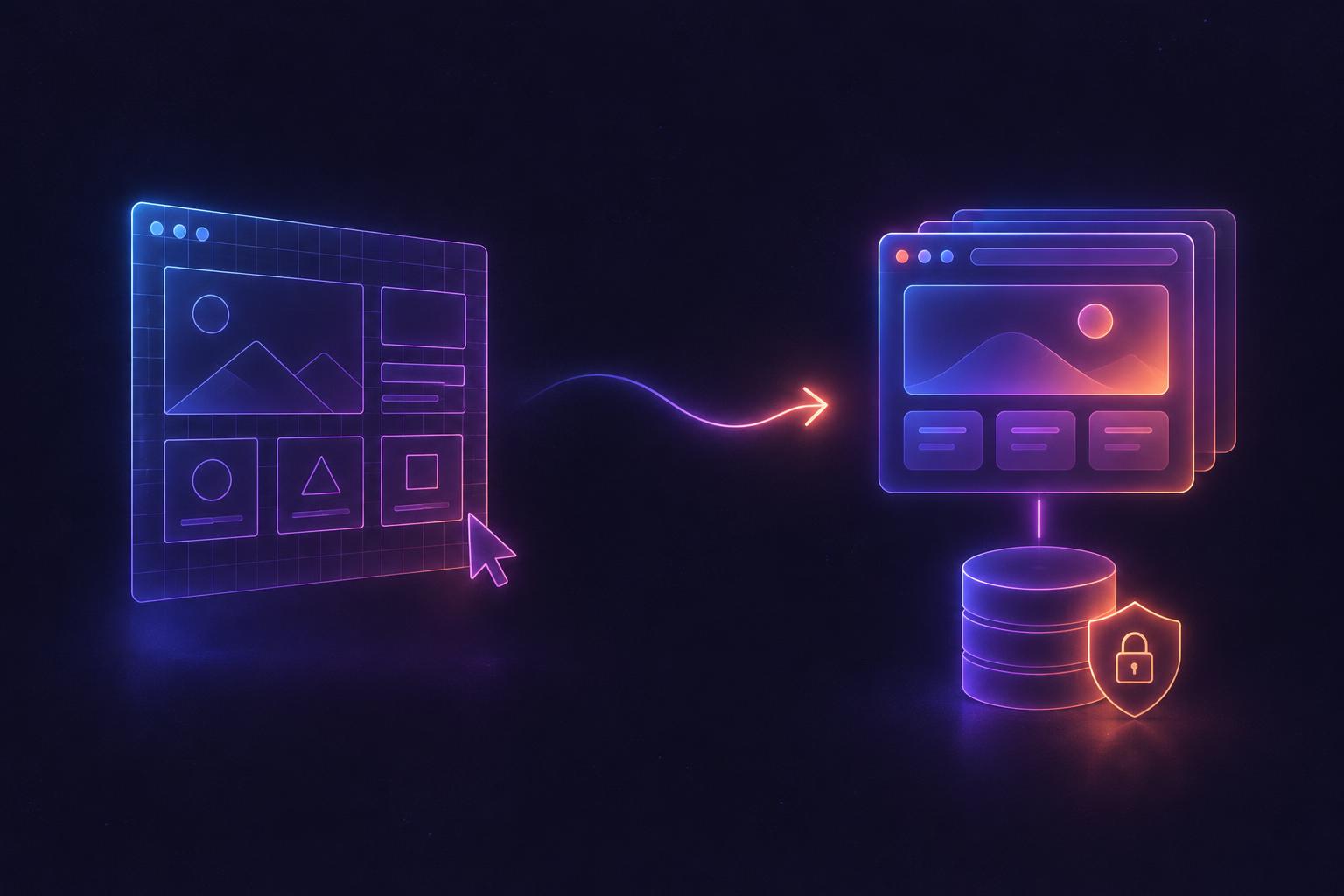
Three features define the workflow. Agent Mode delivers autonomous AI development with independent codebase exploration, proactive debugging, real-time web search, and automated problem-solving. Plan Mode is the planning layer, where you explore approaches and create detailed implementation plans before any code gets written. Visual Edits delivers direct UI manipulation that lets you click and modify interface elements in real-time without writing prompts.
The infrastructure layer is where the gap between these tools widens most. We connect directly to Supabase for PostgreSQL databases and authentication, GitHub for version control and code ownership, and Stripe for payment processing. Hosting, SSL, and CDN delivery are handled automatically through Lovable Cloud.
For builders who want a faster starting point, Lovable's templates give you production-ready foundations across SaaS applications, e-commerce stores, portfolios, and more—each customizable through Visual Edits or natural language prompts.
Lovable's Pro plan costs $25 per month with 100 base credits plus 5 daily credits. A free tier is available for exploration, and a Business plan at $50 per month adds team workspaces and SSO.
Lovable vs Windsurf: Head-to-Head Comparison
Both tools accelerate building, but they serve fundamentally different workflows: Windsurf adds AI speed to a developer's existing process, while Lovable replaces the process entirely for non-technical builders.
Setup and Onboarding
The fastest way to understand these tools is to measure how long it takes to go from nothing to a working application.
Lovable runs entirely in the browser: no installation, no environment configuration, no terminal commands. That's the default workflow described in Lovable's getting started docs.
Windsurf requires downloading and installing the IDE and working in a local development environment. Windsurf's official documentation assumes a developer workflow that includes local setup, project configuration, and ongoing code-based iteration.
If you're evaluating Lovable vs Windsurf purely on time-to-first-build, the difference isn't marginal. It's structural.
Full-Stack Capability
With Lovable, you get a full-stack application from a single conversation. Describe what you need, and you get frontend components, backend APIs, database schemas through Supabase, authentication with email and social login options, and deployment—all without touching a configuration file. GitHub workflow and code ownership are built in via the official GitHub integration.
Windsurf helps you write full-stack code faster, but every infrastructure component is your responsibility. You set up the database, configure authentication, choose a hosting provider, and build your deployment pipeline. Cascade can generate the code for all of these, but you're the one connecting the pieces, managing dependencies, and debugging integration issues.
For a developer with an existing stack, Windsurf adds speed without disrupting their architecture. For someone building from scratch without a technical background, Lovable delivers a complete application where Windsurf delivers code that still needs a home.
Iteration Workflow
How you make changes day-to-day is where these tools feel most different in practice.
In Lovable, iteration happens three ways. You can type a prompt like "add a user profile page with avatar and edit button" and get full-stack changes: frontend, backend, and database, generated instantly. You can use Visual Edits to click on any element and adjust it directly, seeing changes in real-time. Or you can export to GitHub and edit code manually. According to Lovable's documentation, the recommended workflow moves from Plan Mode (planning) to Agent Mode (building) to Visual Edits (refining).
In Windsurf, all iteration flows through code. You prompt Cascade within the IDE, review the generated changes across multiple files, accept or modify them, then build and test. There's no visual editor; every adjustment, from changing a button color to adding a new page, goes through the code layer. This gives developers precise control over every line, but it also means every change requires technical understanding.
The practical difference: changing a button color in Lovable means clicking on it and picking a new color. In Windsurf, it means locating the component file, editing the styling code (or prompting Cascade to do it), saving, building, and refreshing. Both work. One assumes you think in code. The other assumes you don't have to.
Infrastructure Ownership
Lovable manages infrastructure by default. According to Lovable's deployment docs, hosting, SSL, CDN, and database services run through Lovable Cloud with one-click deployment. You can migrate to self-hosted environments at any time. The generated codebase works on AWS, GCP, Azure, Netlify, or Vercel without modification, but you don't have to touch any of it unless you choose to.
Windsurf provides no managed infrastructure. Across all deployment tiers (cloud, hybrid, and self-hosted), developers manage their own hosting, databases, deployment pipelines, and security. Cascade can help write the code for infrastructure setup, but the operational responsibility stays with you.
This is genuinely a preference split, not a quality gap. Developers who want to control their deployment architecture will find Lovable's managed approach limiting. Builders who don't want to think about servers will find Windsurf's self-managed model overwhelming.
Pricing Model
These tools use different credit systems that aren't directly comparable. Lovable uses interaction-based credits: each interaction with the AI consumes credits, with consumption varying by project complexity. Windsurf uses prompt credits, where each prompt to Cascade counts against your allocation (see Windsurf's usage docs).
Lovable's Pro plan at $25 per month includes 100 monthly credits plus 5 daily credits, with rollover and on-demand top-ups. Windsurf's Pro plan at $15 per month includes 500 prompt credits, with add-on credits available at 250 for $10 that never expire.
The sticker price favors Windsurf, but the total cost equation depends on what else you're paying for. Windsurf's price covers AI coding assistance; hosting, databases, and deployment are separate expenses you manage. Lovable's price includes the AI builder plus managed hosting, database provisioning, authentication, and deployment. For a non-developer who would otherwise need to pay for multiple services (or hire someone to set them up), Lovable's higher per-month cost may be the lower total cost.
Who Should Use Which Tool
When building an MVP to validate an idea: Lovable. You need to validate a product idea, not learn DevOps. Many builders end up with functional MVPs in hours to days. The setup friction is near zero, and you get a deployed application, not a codebase you need to figure out how to host.
When prototyping a feature for user testing: Lovable. When you need a working prototype for user testing or stakeholder buy-in, Visual Edits and Plan Mode let you iterate in real-time without waiting on engineering. What takes weeks in a sprint backlog takes an afternoon with a prompt.
When you already have a codebase and want AI to speed up delivery: Windsurf. Cascade's multi-file editing, terminal automation, and project-wide understanding plug directly into your workflow (see the official Cascade docs). You keep your architecture, your deployment pipeline, and your version control setup, everything just moves faster.
When delivering client work under tight timelines: Lovable for client-facing MVPs and prototypes that need to ship fast. Windsurf for production builds where the team already has development infrastructure in place. Some teams will use both.
When starting a new project from scratch: This is the genuinely close call. If you want to control every architectural decision and you're comfortable managing infrastructure, Windsurf gives you AI-powered speed with full ownership. If you want to skip the boilerplate and get to a working product fastest, Lovable, with its vibe coding approach, gets you there before you'd finish configuring your dev environment.
The Verdict on Lovable vs Windsurf
There's no universal winner here because these tools solve different problems for different people.
Windsurf is a powerful IDE for developers who want AI to amplify their coding speed while maintaining complete control over code, architecture, and infrastructure. If you think in code and want to stay in code, it's a strong choice.
We built Lovable for anyone who wants to go from description to deployed application without managing the infrastructure in between. If you care more about having a working product than about how the code is structured, Lovable removes the barriers that make building hard.
The deciding question isn't which tool has better AI. It's whether you want an AI assistant inside your development environment, or an AI builder that is the development environment.
If you've read this far and Lovable fits your workflow, the fastest next step is to start with a template. Whether you're building a client portal, a SaaS tool, or a landing page for a new product, explore Lovable's templates and have something running today: no IDE setup, no infrastructure decisions, no waiting on engineering.
Pricing and product feature information in this article reflects what was publicly available as of March 2026. Both Lovable and Windsurf update their plans, credit systems, and capabilities regularly. Before making a decision, verify current pricing and features directly on the Lovable and Windsurf websites, as well as each platform's official documentation.