When Atonom's CRO Gabe Larsen looked at their Salesforce bill, he didn't see a growth investment. He saw friction. "It was 40 grand a year for 25 or 30 people. We were just like, this is crazy for the functionality we need."
Atonom builds "cloud employees" — advanced AI agents that handle sales development, customer support, and operations across phone, email, SMS, and chat. They're a small team that wants to build fast and limit admin overhead.
Salesforce wasn't helping them stay lean. Neither were the alternatives. They looked at HubSpot, Pipedrive, and others. Every option felt like the same story in a different wrapper: expensive, heavy, and built for organizations with far more complexity than they actually had.
Eventually, they thought they might just go to Excel or Google Sheets because the CRMs were too much work or too expensive.
"I'm going to build you a CRM."
The pivot didn't come from sales. It came from finance.
Jason, Atonom's Head of Finance and Legal, had been experimenting with Lovable. He made Gabe an offer: "I'm going to build you a CRM." Gabe laughed it off.
Jason took it as a challenge. Within three hours, he had a working prototype. They put it in front of the sales team, started collecting feedback, and then suddenly, nobody was logging into Salesforce anymore.
$40,000 → $1,200, no functionality lost
Today, Atonom runs its entire CRM on Lovable. Annual cost: roughly $1,200 including hosting. Previous cost: $40,000. But the savings went beyond the subscription. They eliminated a dedicated CRM admin. No more implementation cycles. No dev team tied up in configuration. No ongoing maintenance complexity.
"We don't have a ton of time to have three people dedicated to this thing. Our head of finance is more or less running it on his spare time."
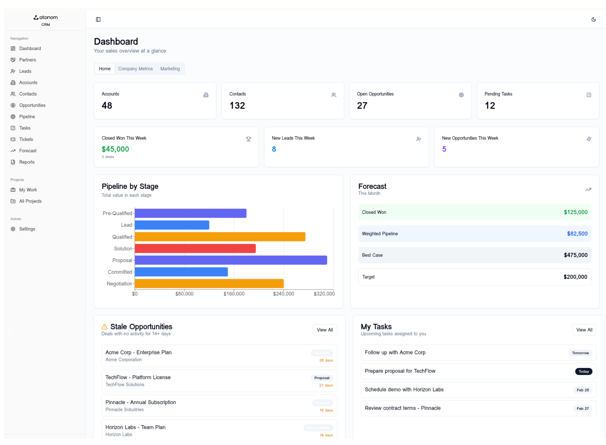
The system handles everything they actually need: lead capture and tracking, lead source categorization, automatic account and opportunity creation, ARR/MRR tracking, probability weighting, weekly focus flags for pipeline reviews, sales dashboards, and basic reporting.
It's where their weekly sales meeting lives now.
"This is where we spend 80% of our time. What deals, which ones are hot, what are we going to close this week."
Does it have every bell and whistle of HubSpot or Salesforce? No. Does it need to? Also no. It's purpose-built for how they actually operate.
Then they connected the Atonom AI SDR
Because Atonom owns the CRM codebase, they could wire it directly into their own product.
When a new lead submits a form, the Lovable CRM creates the record, generates an opportunity, and triggers their AI SDR — an agent called Zoey that handles phone calls, email follow-ups, SMS, LinkedIn outreach, and meeting scheduling.
"Zoey's now fully integrated with Lovable. The lead jumps into Lovable, and then it triggers these actions."
Slack alerts keep the team in the loop: "New lead just came in… Zoey is calling it currently."
The CRM doesn't just store pipeline. It activates it.
Building beyond CRM
Once the CRM was stable, Jason kept building.
Finance now runs contract-based revenue modeling, budget tracking, forecasting, and executive dashboards inside Lovable. "I took our executive board dashboard and just said, build a dashboard like this. End of month, it just automatically updates."
Marketing is next. They've been running project management in spreadsheets; this quarter they're building a purpose-fit tool instead of buying another SaaS seat.
Each function at Atonom now owns one internal build. The pattern is the same every time: start with a spreadsheet-level problem, build a working version in hours, iterate from there.
Why it matters
Atonom realized that building internally gave them speed, flexibility, and control that procurement never would.
"It's a little bit off if we're selling AI agents and telling people to be more agentic — and yet we're using Salesforce and hiring 500 people."
For a growing startup, the math has changed. Off-the-shelf software promises convenience, but it comes with someone else's assumptions baked in about how you should work, what you should pay, and how fast you're allowed to move. Building gives you leverage. The tools to do it are finally good enough that the old calculus no longer applies.
Try Lovable for free today.