Over 159 million .com domains are already registered. Your perfect business name might be available, just not where you expected.
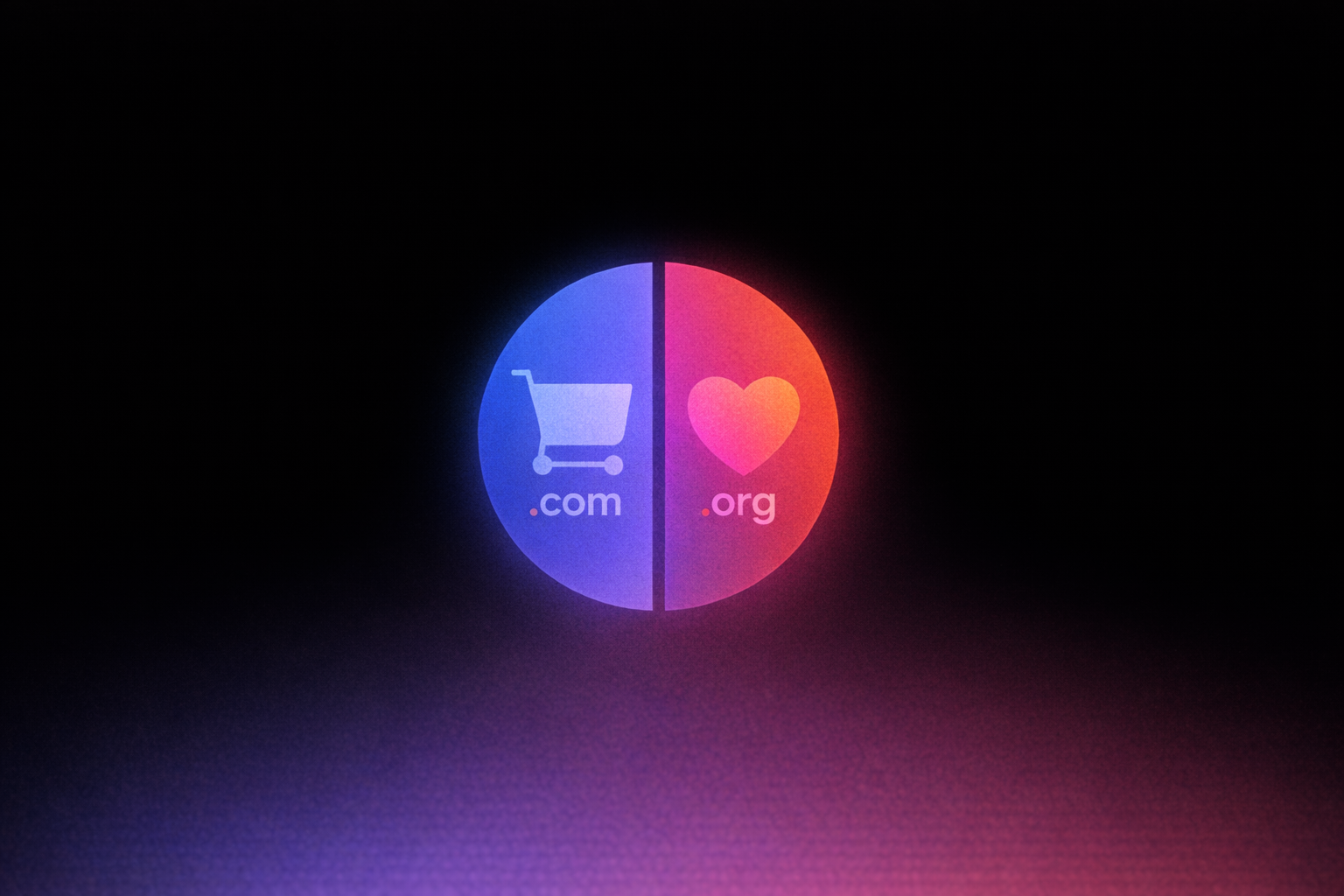
Meanwhile, the .org extension has approximately 11 million registrations, offering significantly more naming flexibility for the right type of organization. The choice between .org vs .com shapes how visitors perceive your brand before they ever click through to your site.
Your domain extension does more than provide a web address: it signals intent, establishes credibility, and sets expectations about what visitors will find. If you're building an online presence, understanding the practical differences between these two extensions can save months of brand confusion and help you avoid costly rebranding efforts.
The .com Advantage: Universal Recognition and Commercial Credibility
The .com extension dominates the internet for good reason. A 2016 study commissioned by ICANN and conducted by Nielsen found that 95% of consumers were aware of .com domains, the highest awareness rating of any extension. The same study found .com, .net, and .org rated highly (91%) as trustworthy destinations on the Internet.
When someone mentions a company name, most people automatically assume a .com address follows.
This default assumption carries real weight. Research from GrowthBadger found that participants were 3.8 times more likely to assume a URL ends in .com when misremembering web addresses. The same study rated .com domains at 3.5 out of 5 for trust perception. The study also found .com URLs had a 44% memorability score, compared to 33% for .co and 32% for .org—meaning .com URLs are over 33% more memorable than URLs with other top-level domains.
Choosing Between .com and .org: A Decision Guide
The ubiquity of .com extends to hardware design. Most smartphone keyboards include a dedicated .com button, reducing friction when users type your address. This small detail reflects the extension's market share: 159.4 million registered domains as of Q3 2025, per the Verisign Domain Name Industry Brief.
When selling products or services commercially, .com offers strong brand positioning and carries a slight trust advantage. The GrowthBadger study shows .com domains score 3.5/5 for trust compared to .org's 3.3/5, and users remember .com addresses more reliably than alternatives.
E-commerce stores, service businesses, and SaaS products all benefit from .com's widespread familiarity and high consumer recognition. However, mission-driven for-profit businesses and consulting practices emphasizing community or social impact may find .org more aligned with their positioning, even though both extensions enjoy strong public credibility.
The extension works particularly well when your audience spans multiple demographics or when you're building a brand that might expand internationally. Unlike country-code domains that Google geo-targets to specific regions, .com has no geographic limitations and serves global ambitions without the geographic constraints of country-code extensions.
The .org Distinction: Mission-Driven Positioning and Community Trust
The .org extension carries different weight entirely. The same ICANN-commissioned study showed 83% consumer awareness for .org—lower than .com's 95%, but still remarkably strong for an extension primarily associated with nonprofits and community organizations.
What .org lacks in raw memorability, it gains in specific trust contexts. Organizations like Craigslist, a for-profit platform, use .org to emphasize community focus over commercial intent.
The extension has become established shorthand for "mission over profit" among nonprofit organizations and community-focused entities. When visitors see a .org address, they expect community focus, transparency, and values-driven operation.
Who Actually Uses .org
A common misconception suggests .org requires nonprofit status. Public Interest Registry, the designated registry operator for .org domains, confirms the extension remains completely unrestricted: "There are no restrictions based on geography. Registrants are not required to demonstrate non-profit status."
Anyone can register a .org domain, including for-profit businesses, without eligibility requirements or special approval.
This open policy enables positioning choices. Craigslist operates as a for-profit company but uses craigslist.org to emphasize community service over commercialization. Classy, a for-profit SaaS platform, uses classy.org to align with the nonprofit fundraising sector it serves.
Both companies use .org to signal mission alignment and community focus rather than pure profit motives, demonstrating how for-profit businesses can use the .org extension to strengthen their positioning in mission-driven markets.
The extension's commitment shows in renewal behavior. Data from the Verisign Q3 2025 Domain Name Industry Brief reveals .org maintains an 86.2% renewal rate, the highest among all major domain extensions, compared to 75.3% for .com and .net combined. Organizations holding .org domains value them enough to keep renewing year after year.
.org vs .com: Head-to-Head Comparison
When evaluating these extensions side by side, five factors matter most for your decision.
User Trust and Perception
- .com: 3.5/5 trust rating per GrowthBadger, 95% consumer awareness per ICANN/Nielsen 2016 study, stronger memorability (44% vs 32%)
- .org: 3.3/5 trust rating per GrowthBadger, 83% consumer awareness per ICANN/Nielsen 2016 study, strong nonprofit association
Winner: .com for general commercial purposes; .org for mission-driven positioning.
Availability and Naming Flexibility
- .com: 159.4 million registered domains; high competition for desirable names
- .org: Approximately 11 million registered domains; significantly better availability
Winner: .org represents only about 7% of .com's scale, offering substantially better name availability.
SEO Considerations
- .com: No ranking advantage per Google
- .org: No ranking disadvantage per Google
Winner: Tie. Google's John Mueller has confirmed: "The newer top-level domains (TLDs) are equivalent to other generic top-level domains like .com when it comes to SEO."
Pricing and Registration Costs
- .com renewal at Cloudflare: Approximately $10.44/year (at-cost pricing; verify current rates)
- .org renewal at Cloudflare: Approximately $7.52/year (at-cost pricing; verify current rates)
- .com renewal at GoDaddy: $21.99/year
- .org renewal at GoDaddy: $22.99/year
Winner: Nearly identical pricing; registrar choice matters more than extension.
Brand Alignment and Audience Expectations
- .com: Commercial credibility, broad audience appeal, international scalability
- .org: Community focus, mission-driven positioning, nonprofit sector alignment
Winner: Depends entirely on your organization's purpose and audience.
Each factor carries different weight depending on your specific situation, so consider which of these five areas matters most for your goals before making a final decision.
Use Case Recommendations
Different business types benefit from different extensions. Here's how to match your domain choice to your specific situation.
When Selling Products or Services Online
Choose .com for maximum commercial visibility. The GrowthBadger study found .com had a 44% memorability score versus 32% for .org and users were 3.8 times more likely to default to .com when recalling website addresses. Whether you're selling products, offering services, or building a SaaS platform, .com conveys established commercial positioning to potential customers.
If Your Organization Focuses on Charitable Work
Choose .org. The extension's strong association with mission-driven work supports fundraising efforts and donor trust.
While the often-cited "72% of donors prefer .org" statistic from a 2017 Enthuse blog post lacks verifiable methodology, the practical reality remains: donors expect nonprofits to use .org addresses.
When Building Open-Source Projects
Consider .org, .dev, or .io depending on your community and technical positioning. The .org extension aligns with community-driven development and nonprofit positioning, offering strong market credibility with approximately 11 million registered domains and an exceptional 86.2% renewal rate per Verisign.
Technical projects often succeed with .dev or .io, which signal developer focus and technical innovation to your audience. Before using project names in domains, review trademark policies like those from the Apache Software Foundation to ensure compliance and avoid legal disputes.
If You're Building a Personal Brand or Portfolio
Choose .com for most situations. The extension's memorability and commercial positioning support freelancers, consultants, and professionals building client-facing presence.
Exception: if your personal brand centers on advocacy, education, or community service, .org can reinforce that positioning and signal mission alignment over profit.
When Running a Mission-Driven For-Profit Business
This category requires the most careful consideration. If your for-profit business serves nonprofit sectors, emphasizes social impact, or prioritizes community over commercialization, .org can strengthen that positioning. Companies like Classy demonstrate this approach successfully.
However, if you're building a scalable commercial brand with broad audience appeal, .com's memorability advantage likely outweighs .org's mission signaling.
What to Do When Your Preferred Domain Is Taken
With 159.4 million .com registrations, your first-choice domain probably belongs to someone else. Several practical approaches can help.
Name Modifications
Adding descriptive qualifiers often yields available domains without sacrificing brand clarity. Geographic modifiers (ForbesAfrica.com), action verbs (GetYourBrand.com, ShopBrandName.com), and industry terms (BrandNameHQ.com) all create viable alternatives that can support growing businesses.
Prefixes work similarly well. "The" prefix (TheCompanyName.com) and possessive forms (MyBrand.com, OurBusiness.com) often remain available when base names are taken.
Alternative Extensions
Since Google treats all generic top-level domains equally for search rankings, alternatives like .co, .io, and .net carry no SEO penalty. The choice between extensions should be based on brand positioning and audience expectations rather than search engine optimization.
Each serves different positioning needs: .co works for startups and modern brands seeking an alternative to .com, .io appeals to the developer and tech community, and .net is familiar to those seeking non-.com options in the technology sector.
Avoid country-code extensions (.uk, .ca, .us) if you plan international expansion, as Google geo-targets these to specific countries, limiting your global reach.
Multi-Domain Protection
Once you secure your primary domain, consider registering common misspellings and variations as part of a multi-domain protection approach. Redirect all variations to your main address using 301 redirects, which preserve your SEO value and prevent customers from getting lost.
This approach matters because research shows internet users are 3.8 times more likely to default to .com when misremembering addresses. However, avoid duplicating content across multiple domains: this creates SEO penalties rather than benefits. The key is using redirects to protect your brand without creating separate content silos that harm your search visibility.
Domain Acquisition
When an important domain is taken, direct purchase remains an option. Use WHOIS lookup to find owner contact information, send a professional inquiry explaining your business interest, and use escrow services for safe transactions.
Realistic pricing for solo entrepreneurs ranges from $100-$5,000 for simple domains, though premium names command significantly higher prices.
Before purchasing any domain, verify it isn't trademarked by another entity. Trademark conflicts can force you to surrender a domain regardless of purchase price.
Choosing the Right Registrar
Registrar choice affects your long-term costs more than extension choice. Cloudflare offers domains at cost with identical pricing for both registration and renewal—no surprise increases. (Pricing changes periodically; verify current rates before purchasing.)
Porkbun offers competitive pricing with free SSL and WHOIS privacy included. Meanwhile, GoDaddy charges $21.99/year for .com renewals, roughly double at-cost registrars' rates. This difference compounds annually, making registrar choice far more impactful than whether you choose .com or .org.
Watch for promotional pricing traps. Some registrars advertise $0.01 or $0.99 first-year pricing that jumps dramatically on renewal. Always evaluate renewal rates, which determine your actual long-term costs. Compare registrars carefully and look for consistent pricing between registration and renewal with no surprise increases.
Start With Your Purpose
The .org vs .com decision ultimately reflects your organization's identity and audience expectations. Commercial businesses serving general audiences benefit from .com's memorability and universal recognition. Mission-driven organizations, nonprofits, and community-focused projects align better with .org's positioning.
Neither extension affects your search rankings: Google has confirmed this explicitly. Both cost roughly the same at reputable registrars. The meaningful difference lies in perception: what does your domain extension tell visitors about who you are and what you value?
If you're building a business to generate revenue from broad consumer audiences, choose .com. Per the GrowthBadger study, it has a slight edge in trust (3.5/5 vs 3.3/5) and higher memorability (44% vs 32%).
If you're building something that prioritizes community, mission, or social impact, .org reinforces that identity and has no registration restrictions for mission-driven organizations. If both extensions for your preferred name are taken, the approaches above—name modifications, alternative extensions, and multi-domain approaches—provide practical paths forward.
Once you've secured your domain, the real work begins: building what goes on it. Start building with Lovable and turn your domain into a working application without writing code.