A revenue stack built in-house saves over $1M in annual licensing. Rather than procuring vendor software for pipeline insights, onboarding, partner management, and deal desk operations, the team built its own tools for every workflow across the revenue org.
Automated rep onboarding replaces manual practice calls, saving managers ~400 hours per year. Instead of sitting through passive video modules and scheduling one-off roleplays, incoming reps practice pricing and objection handling out loud with on-demand AI voice simulations.
Contract approval timelines drop from days to minutes, replacing six-figure software. Reps previously drafted static order forms and chased sign-offs across email and Slack. A guided pricing calculator with built-in guardrails now lets the team model usage, route approvals, and send agreements in a single flow.
Dedicated customer onboarding portals replace manual handoffs, saving ~3,000 hours per year. Rather than waiting on manual kickoff calls and scattered email handoffs, new enterprise accounts get an immediate workspace that guides setup and team access from day one.
Most revenue teams are stuck with point solutions that create more problems than they solve: too much admin work and too many interfaces that create switching costs and drag for sellers, pricing systems that are painful to tailor to the business, and disjointed experiences for partners trying to log sourced leads or track the product roadmap. At Lovable, rapid growth and exploding inbound interest took that pressure to an extreme. For the founding revenue team, there were simply more customers to talk to than hours in the day, and systems and tools needed to take on the brunt of the work to free up the team to close deals.
When enablement leaders Morgan Jacobson and Cody Normand joined Lovable, cutting down the administrative drag was priority one. They quickly noticed something interesting: account executives (AEs) had already built their own Lovable apps to eliminate daily headaches. One AE built an interface pulling live product usage signals alongside CRM records, while others created quick pricing calculators to quote enterprise deals.
Instead of buying new off-the-shelf tools and customizing them, Morgan and Cody asked a different question: what if we took what our AEs built and scaled it across the entire team?
Lauren Rhode, Head of Revenue, immediately backed the idea.
“My teams historically had to bend how we worked around whatever rigid software our company bought. I’ve felt this more deeply every quarter, as the revenue tech stack has proliferated with point solution after point solution, each one trying to fix a single problem and squeeze out a little more productivity. At Lovable, if a repeated action takes manual steps or slows a deal down, we encourage the person feeling that friction to build the tool that fixes it, and we work with RevOps to roll it out to everyone.”
Here is how Lovable’s revenue org from sales to partnerships to RevOps builds, runs, and governs custom software and agents for every stage of the customer journey.
Accelerating eight-figure partner pipeline with a custom portal
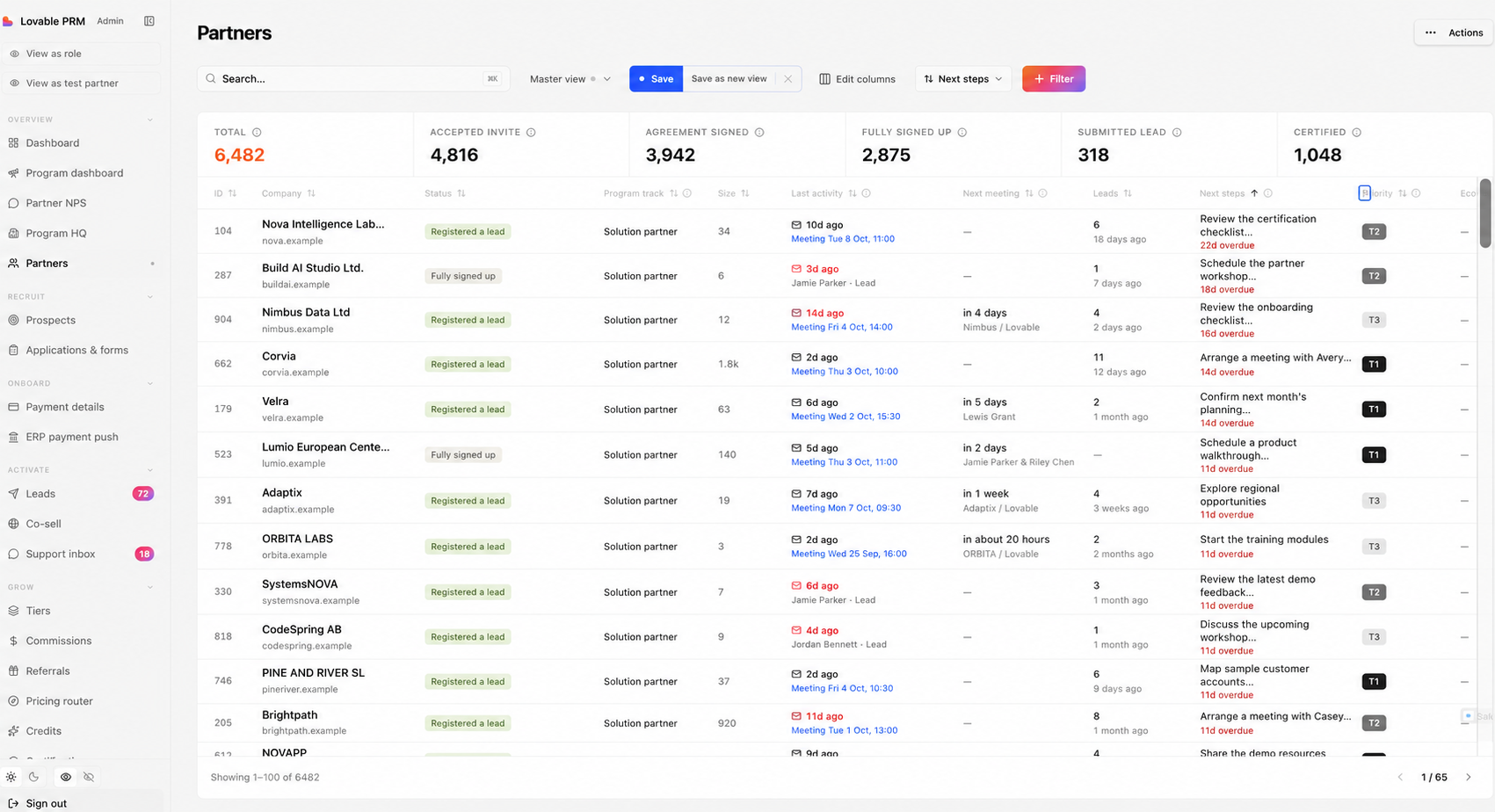
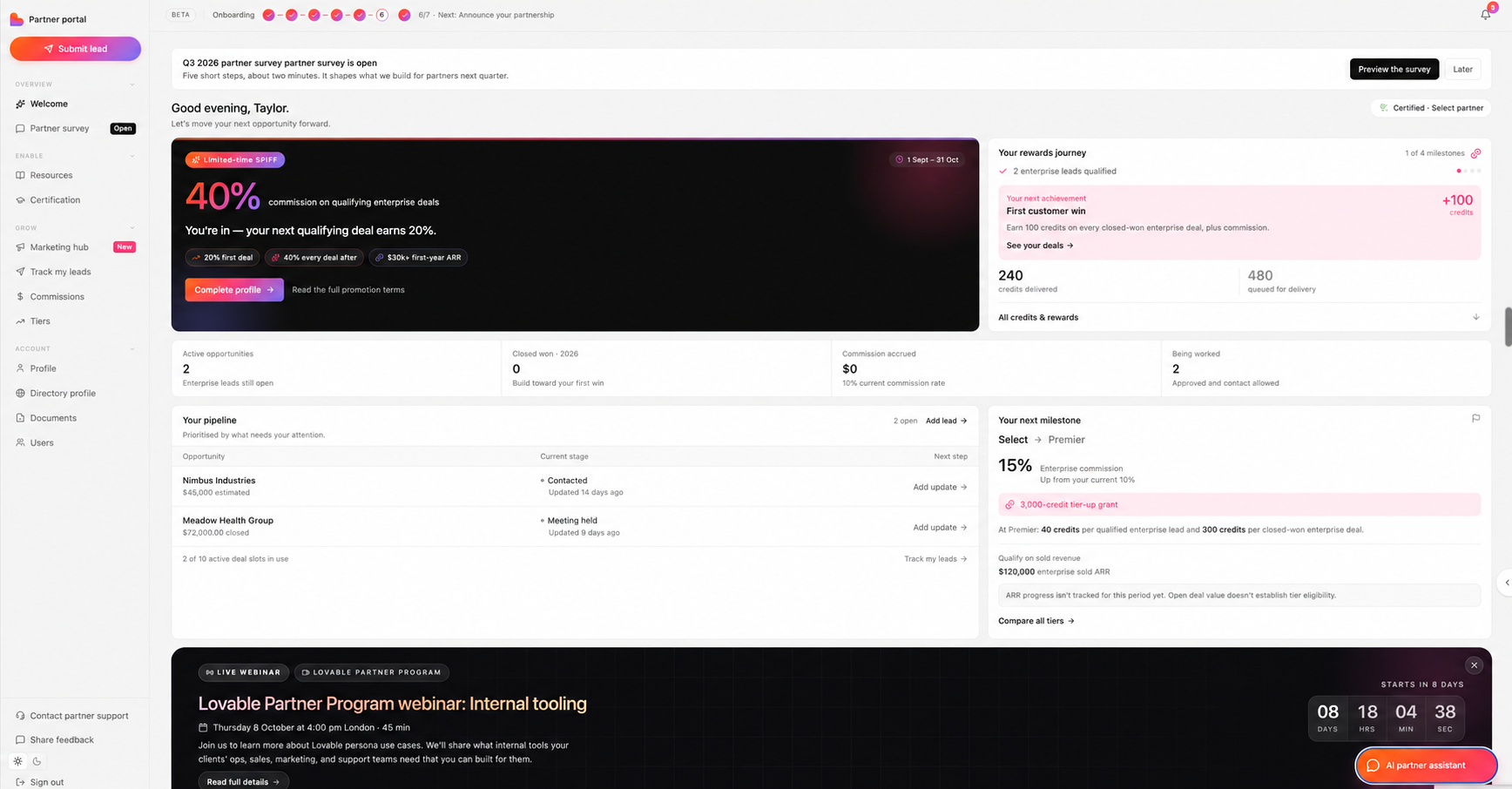
A massive partner ecosystem sprouted organically around Lovable. Every week, thousands of freelancers, agencies, and consultants were building software for their own clients. The revenue team wanted to capture that organic momentum and turn it into a world-class partner program, but doing that required operational infrastructure. Traditional partner relationship management (PRM) tools were notoriously rigid, slow to configure, and expensive. Rather than waiting on months of procurement, Opeid Elsheikh, who leads partner operations at Lovable, decided to build the platform himself.
In three days, he had a working prototype, and just a few weeks later, an end-to-end PRM ready to launch to thousands of partners. The platform includes two dedicated interfaces: an internal command center where partner managers track health, certifications, and pipeline metrics in real time, and an external portal where partners access positioning frameworks, certification paths, and resources to build multimillion-dollar businesses on Lovable.
“We could never have moved this fast and handcrafted a system entirely around the program’s requirements without compromise, if we’d had to procure, implement, and work around an off-the-shelf solution,” says Opeid.
Within two weeks of launch, more than 5,000 partners signed up for the platform, with 1,500 fully onboarded and certified. Beyond activating a global network of builders, the custom portal drove over eight figures in new pipeline and saved the company more than $250,000 in annual licensing costs.
Getting the team customer-ready faster with on-demand AI roleplay
Traditionally, getting new sellers customer-ready takes weeks or months of painful admin work. Sellers don’t want to sit through hours of passive video modules, and sales managers don’t have 20 hours a week to run mock calls.
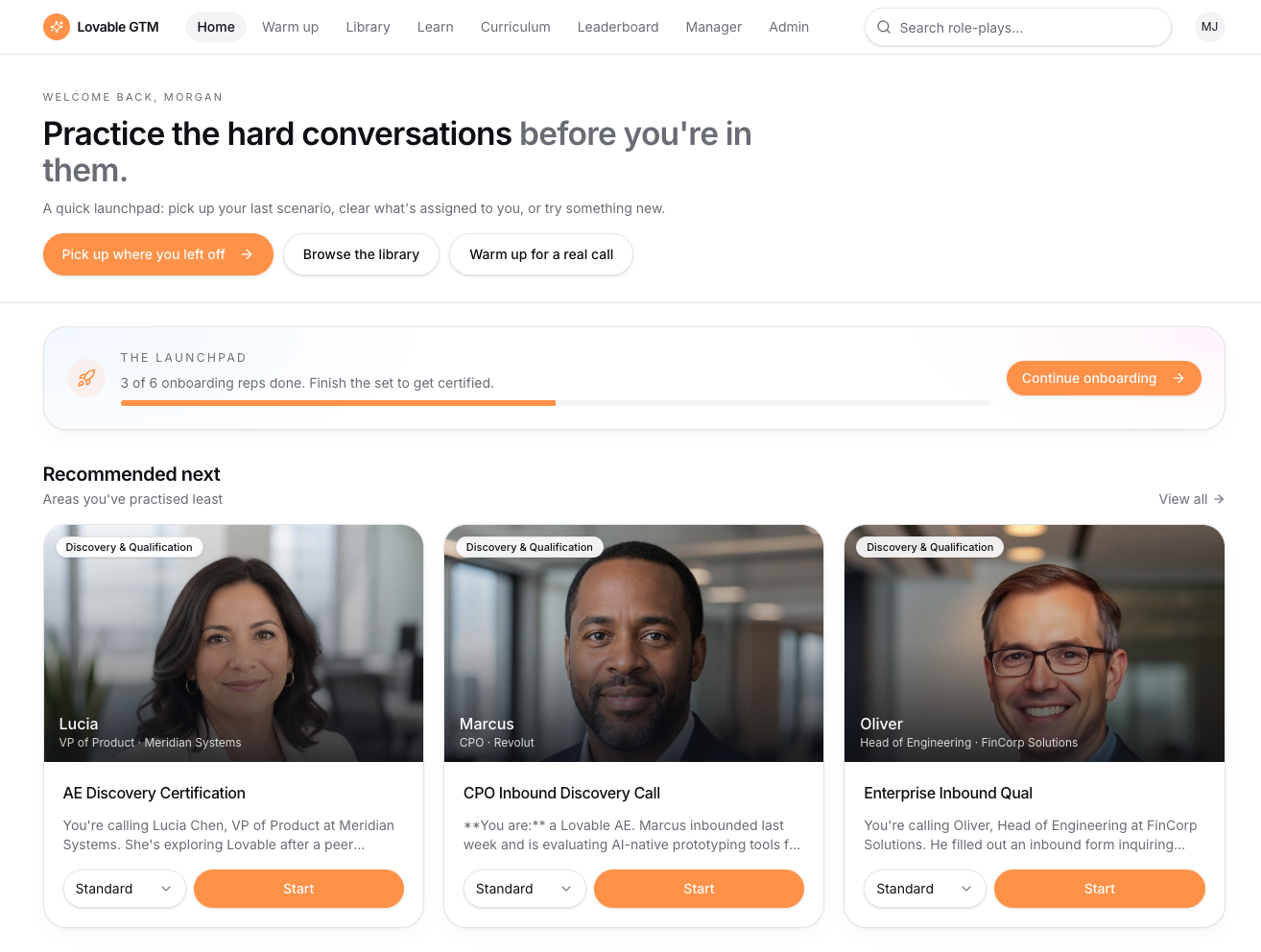
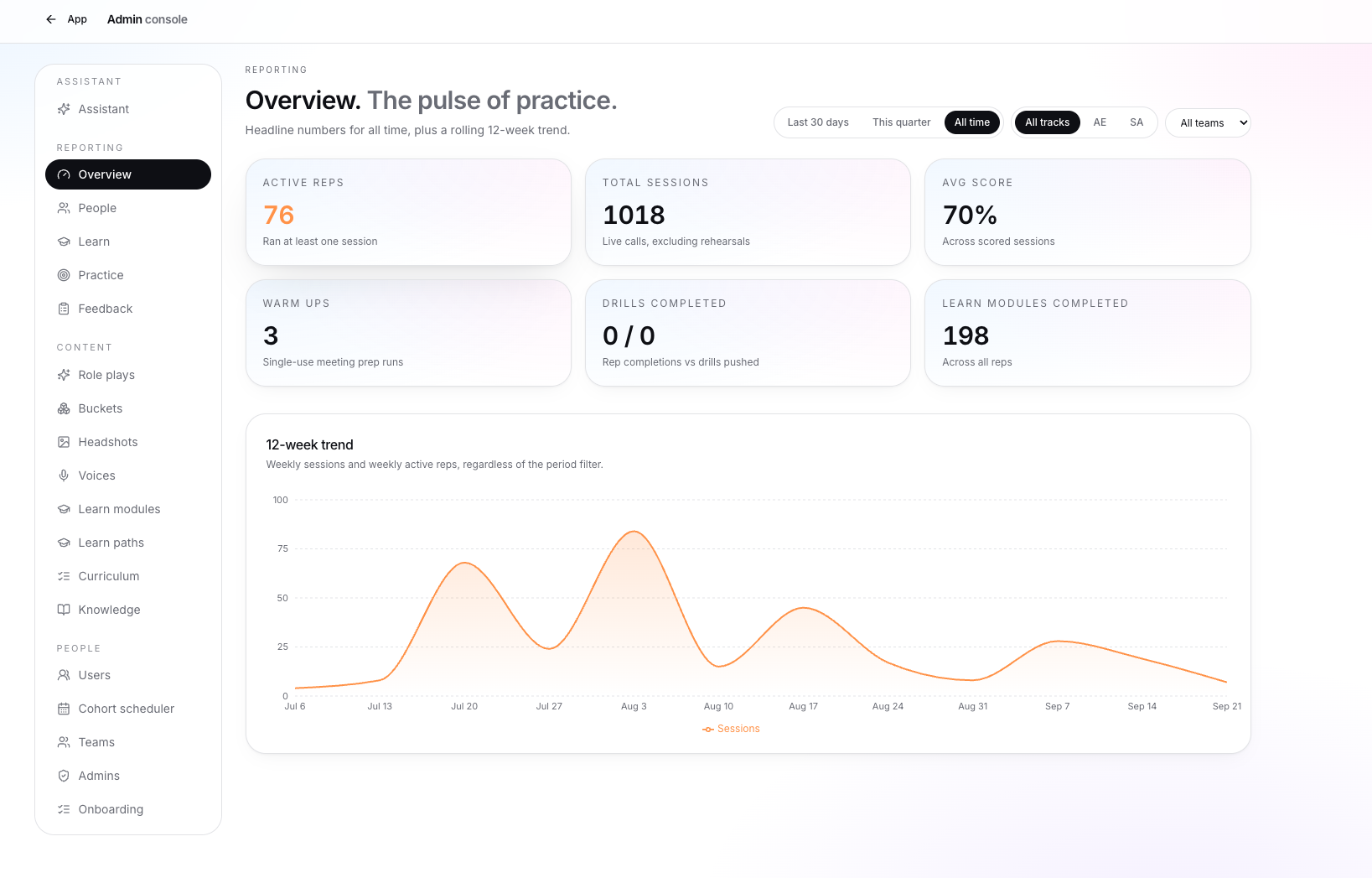
Instead of settling for software they knew the team would resist, Morgan and Cody built a GTM training app with Lovable. From day one, automated Google Calendar invites map out each rep’s milestones, assigning self-paced modules that include interactive roleplays powered by ElevenLabs’ voice AI. Sellers practice discovery, pricing, and objection handling out loud, getting real-time scores that feed directly into a manager dashboard.
“I’ve spent more than 15 years watching companies buy expensive training platforms reps hate using,” says Morgan. “We took everything that failed in past roles and built a tool we knew reps would actually use.”
“Reps can practice a tough pricing conversation out loud, get immediate feedback, and run it again without waiting on a manager,” says Cody. “New reps are usually on live customer calls within two days. At past companies, that took weeks.”
Morgan built the initial version of the training app and rolled it out to the team in just 48 hours. By building in-house, the team cut roughly $50,000 in annual licensing costs that Morgan and Cody knew could easily climb past $500,000 as headcount grew. Beyond software costs, the internal builds gave managers time back: automating cohort scheduling and mock calls freed up an estimated 400 coaching hours each year.
Building high-converting pipeline by turning live product signals into targeted outreach
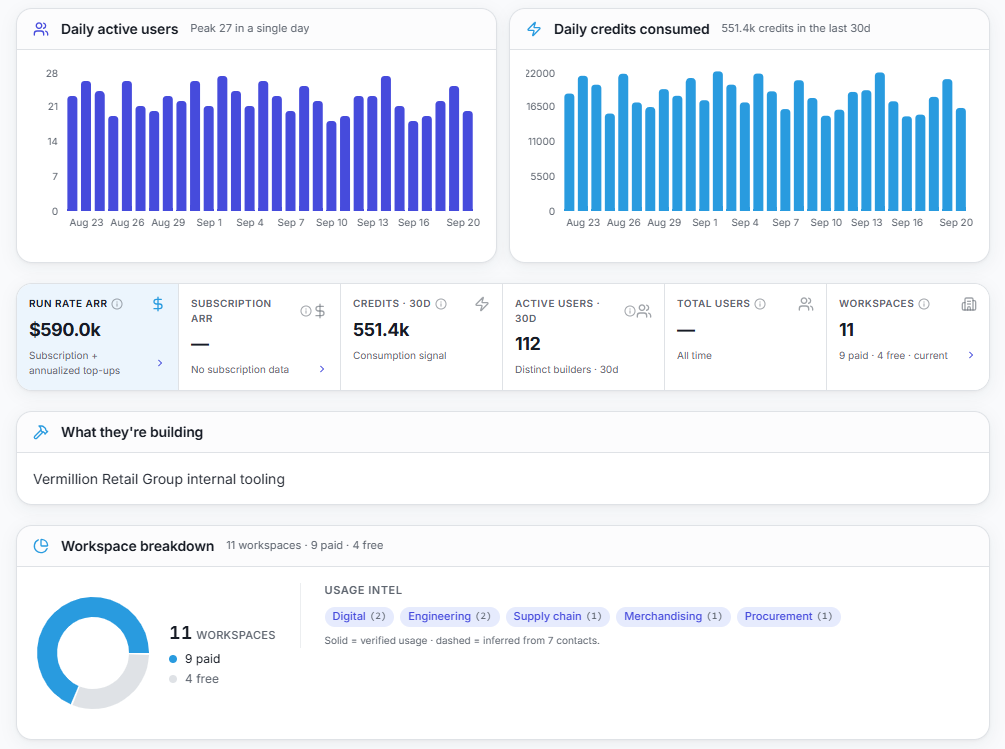
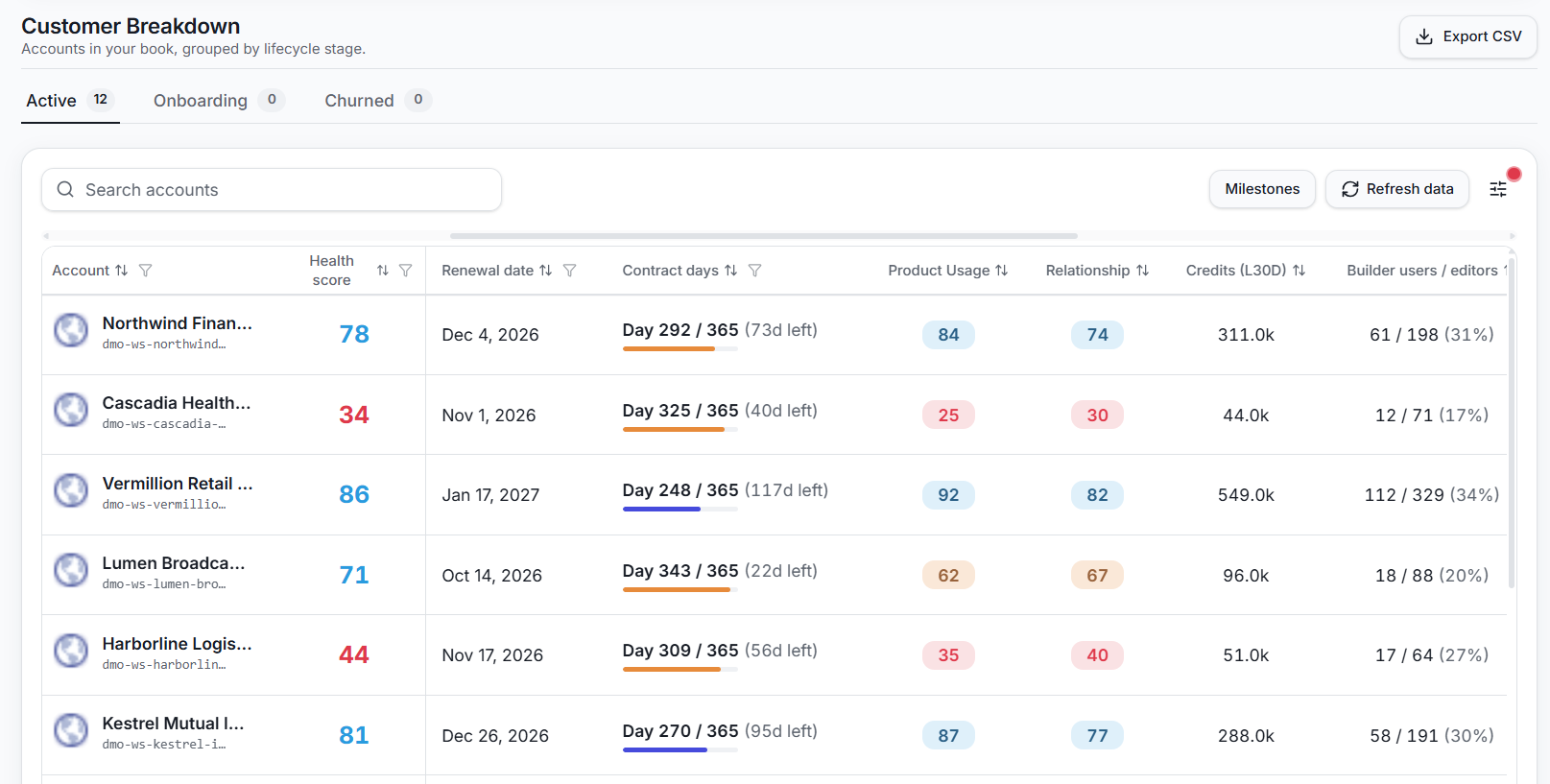
AEs and customer success managers (CSMs) previously tracked product usage, call transcripts, renewal risks, and event invitations across the CRM, other tools, and spreadsheets. Because the data lived in silos, the team often missed critical signals that an account was ready for expansion or at risk of churn.
One of Lovable’s first AEs, Michelle Fitzgerald, felt the pain of toggling between systems. She used Lovable to build the exact interface she wanted, bringing CRM records, product telemetry, and customer communication into a single workspace.
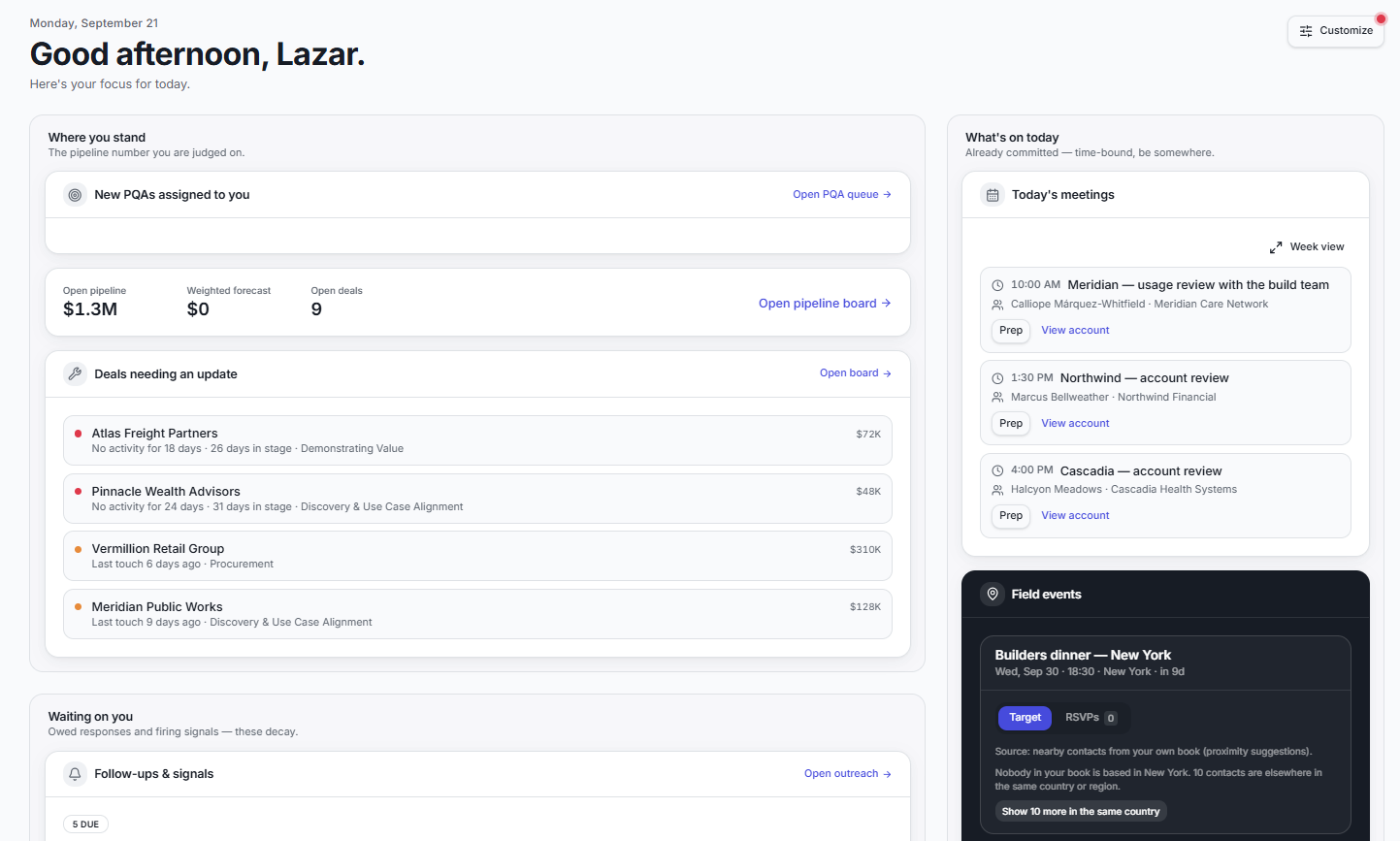
As adoption spread across sales, the customer success team wanted in as well. Lazar Jovanovic, a GTM engineer at Lovable, partnered with the team to scale Michelle’s app into Catalyst, a dedicated go-to-market workspace with role-based views to serve the entire team.
“The CRM still holds the master customer record,” says Lazar. “We built Catalyst around the actions reps and customer success managers actually need to take every morning.”
In the app, AI agents scan real-time product usage and customer milestones, alert the team to expansion signals, and draft outreach tailored to each account. Field teams manage private dinner invitations and track RSVPs directly within the same views. The workspace fits the team’s day-to-day workflow so closely that most have stopped logging into the CRM altogether. Today, 80% of the sales team uses Catalyst daily to manage active pipeline.
Replacing email sign-off chains with built-in pricing and approval guardrails
Custom contracts and non-standard terms previously required the team to draft static order forms and chase deal desk approvers across Slack and email. Lazar and the RevOps team built a deal desk app to eliminate that friction.
The team uses the tool to model usage estimates, route approvals, and generate clean agreements in a single guided flow, with built-in guardrails to catch discrepancies like mismatched entity names or unsupported terms before contracts go out.
Order forms, amendments, and electronic signatures all run through the same interface. Approvals that once took days of back-and-forth now take minutes, with 100% of Lovable’s quotes configured and sent directly through the app. It eliminated the need for complex, six-figure enterprise CPQ software.
“We built Deal Desk to take the guesswork and the waiting out of closing so reps could focus on customer needs, not paperwork,” says Lazar.
Turning post-sale handoffs into self-serve customer onboarding hubs
Closing an enterprise deal used to mean a messy handoff from sales to customer success, usually re-explaining technical requirements over scattered email threads. To keep deal momentum going, AEs and CSMs teamed up to build a dedicated onboarding portal.
Each new account now gets its own dedicated hub where clients can track setup progress, configure integrations, and invite teammates without waiting on kickoff calls. Clients only see their own workspace, while internal visibility is restricted to the assigned AE, CSMs, and the revenue operations team.
By removing manual coordination between AEs and CSMs, the onboarding hub gives back an estimated 3,000 operational hours to the team each year.
Scaling custom tools without the operational headache
Letting sales reps build the tools they need doesn’t have to create chaos for operations. At Lovable, every custom tool follows the same development process: the person closest to the friction builds the initial version, and once it gains traction across teams, revenue operations steps in to support, govern, and scale it.
Each tool writes straight back to Lovable’s CRM and databases, keeping deal updates, customer notes, and usage signals unified in the system of record. Because every app lives in shared company workspaces rather than personal accounts, projects are maintained and secure even if someone leaves. Today, more than 75 team members actively run these apps across 1,000+ sessions every month.
Building in-house also means the software keeps evolving alongside the sales motion. When a competitor shifts their pitch and the training app needs fresh objection scenarios, updates happen immediately.
That continuous adaptation is another major improvement over off-the-shelf software. By letting frontline teams build what works and having RevOps scale what lasts, Lovable gets software that stays tailored to how the team actually sells, while saving hundreds of thousands of dollars each year.
“I’m fired up for the new reality we’re creating. When you put the power to ideate and problem-solve into the hands of the people closest to the problem, and then you set up a loop to choose, harden, and scale the best ideas across the team, the entire go-to-market motion compounds,” says Lauren.

 Lauren RhodeHead of Revenue
 Morgan JacobsonHead of Revenue Strategy & Enablement
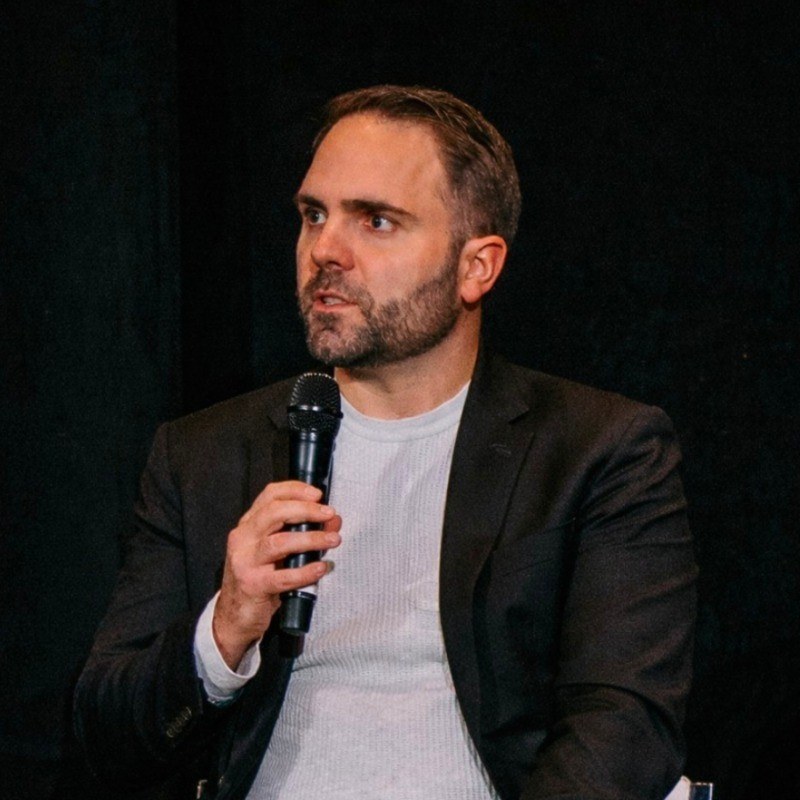 Cody NormandGTM Enablement
 Lazar JovanovicGTM Engineer
 Michelle FitzgeraldEnterprise Account Executive
 Opeid ElsheikhPartner Operations