An AI agent in Slack turns casual requests into complete creative briefs. When someone asks for creative work in chat, the agent prompts them for missing context and builds the brief conversationally, eliminating hours of manual back-and-forth.
A centralized production hub prioritizes creative work based on business impact. By connecting request intake directly to team capacity boards, creative leads can balance workloads across four disciplines and complete over 50 briefs each month.
A self-serve brand portal protects visual identity while eliminating routine asset requests. An interactive portal gives employees, partners, and ambassadors instant access to approved assets, automated format generators, and an AI brand agent, recording nearly 10,000 visits in October.
Lovable has built a beloved brand with an unmistakable visual identity. As the company scales, the challenge has shifted from establishing that identity to protecting and scaling it.
Lovable’s creative and design teams built custom software to solve this: an intake agent in Slack to triage creative requests; a shared operating system to coordinate production across creative, brand, social, and web disciplines; and a self-serve “brand engine” that empowers everyone to ship on-brand collateral.
Nad Chishtie was one of Lovable’s earliest hires, brought on as Head of Design when the company was just a handful of people. That decision showed how deeply Lovable’s founders prioritized brand from day zero, and it remains a core differentiator today.
Lovable’s brand has earned deep trust and affection from our community, and protecting that reputation is
non-negotiable as we scale. Creative sets the standard, and our job is to make sure everyone inside and outside the
company can uphold it easily. We built our own software so high-impact creative projects get prioritized and delivered
cleanly, while routine brand enablement happens automatically.
Nad Chishtie, Head of Design
Turn incoming Slack requests into structured briefs without chasing context
Creative requests often start as quick, casual messages between team members: a marketer needs a deck graphic by Friday; a product lead wants an illustration for an upcoming launch. These asks can quickly pile up in siloed conversations and project-specific Slack channels, and they rarely include the specs, dates, or context needed to get started. Creative teams are left chasing details rather than focusing on the work.
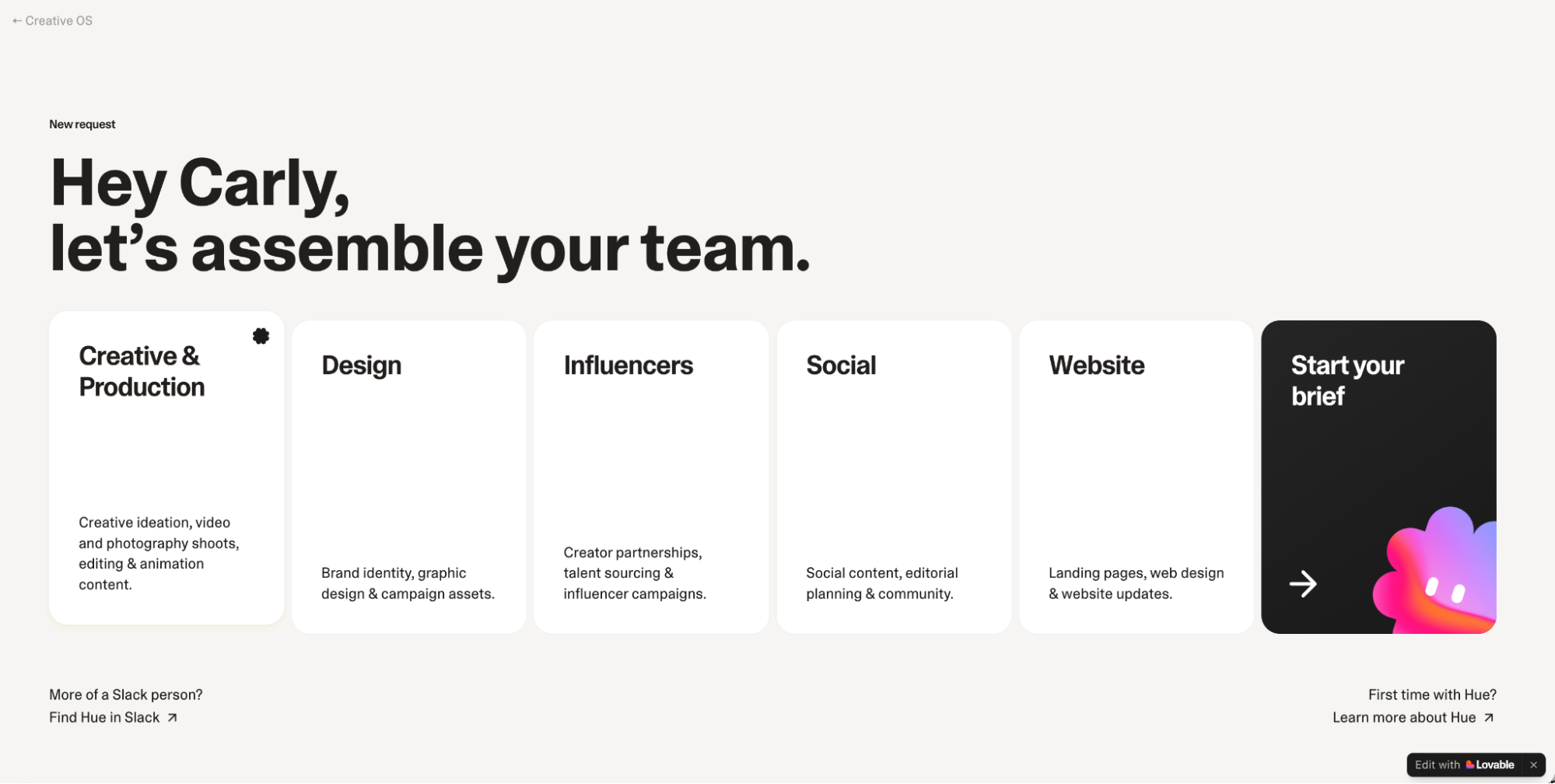
To solve for this at Lovable, the team built Hue, a conversational department agent that lives directly in Slack channels and in direct messages. Requesters talk to Hue to pitch an idea, ask for an asset, or brainstorm creative directions when they are not sure where to start. Hue helps shape the concept, checks for duplicate asks across active projects, and prompts the requester for missing context right in the thread.
Before adding anything to the project management board in Lovable, Hue sends a confirmation card in Slack for the requester to verify with one click. Once confirmed, Hue links the project to the right board, assigns ownership, and provisions a shared Google Drive folder so assets don’t get lost in chat threads. Hue also handles the rest of the operational loop: updating deadlines, answering progress questions, and delivering final asset links back into the original conversation once work is done.
Carly Old manages creative production across campaigns, as well as general video and photography needs. Before Hue, her days were dominated by digging through noisy Slack threads just to piece together what teams were actually asking for.
Nobody likes filling out creative request forms. They just want to send a quick message in Slack. We leaned into that
instead of fighting it. Hue takes all the casual messages, asks further questions on our behalf and turns them into a
brief we can work with. Hue manages the back-and-forth to make sure that we have all the information that we need,
which saves us hours every day.
Carly Old, Creative Production
Balance capacity and deadlines across four disciplines in one workspace
Intake is only the first step. Once projects are approved, managing production across brand, social, creative, and website teams requires clear visibility into who is working on what. When teams track projects in separate spreadsheets, personal notes, and disconnected boards, nobody knows true capacity. Deadlines slip, work is duplicated, and leadership has to guess what can realistically ship each sprint.
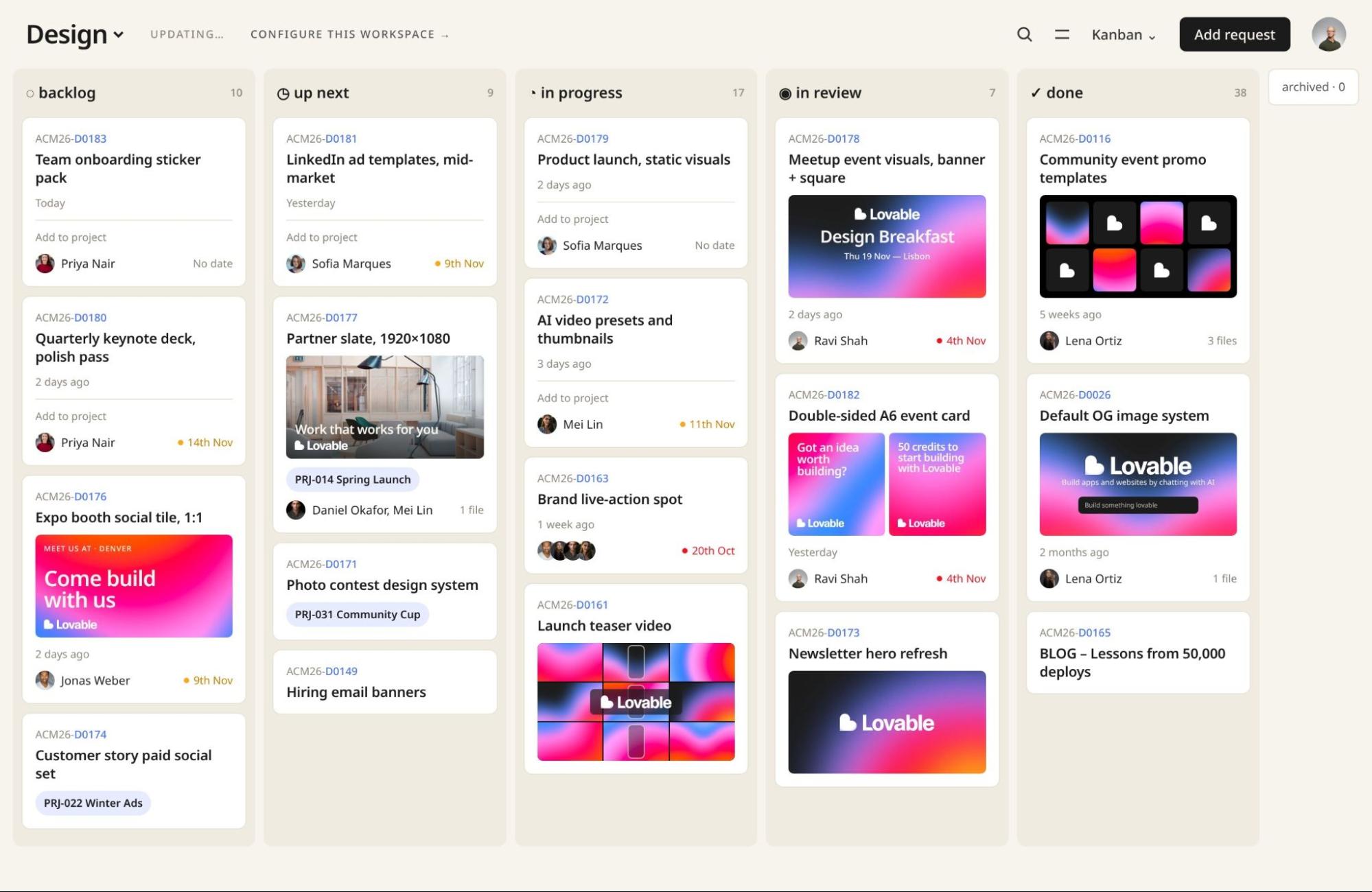
The team built Creative OS to be the centralized command center for all creative production at Lovable. Creative OS is so effective that the team is now able to complete over 50 briefs each month. The web app houses every project, incoming request, team board, and asset in one place. Creative leads use it to review incoming volume, balance workloads across specialists, and make transparent commitments on delivery dates. Designers get a clear view of their active queue without having to manually log in to adjust status tags. Because Hue reads and writes to Creative OS, status changes, assignee handoffs, and timeline adjustments happen naturally through conversation.
For Carly, having a single source of truth changed how creative commitments get made across the entire company.
Before Creative OS, every sub-team tracked work differently, and nobody had a clean view of our collective capacity.
Now, when marketing or sales needs something, we look at the board together, see what is already committed, and make
honest trade-offs based on business goals. The best part is that designers never have to stop working just to update
fields in a database, because Hue syncs everything straight from Slack conversations.
Carly Old, Creative Production
Protect brand integrity while empowering everyone to self-serve
When hundreds of people independently create marketing collateral, protecting brand integrity without slowing down advocacy becomes a constant challenge. Out-of-date logos, inconsistent typography, and inaccurate brand colors seem inevitable. If those assets are buried in static PDF brand guides or Google Drive folders, people either interrupt designers for simple exports or create off-brand assets on their own.
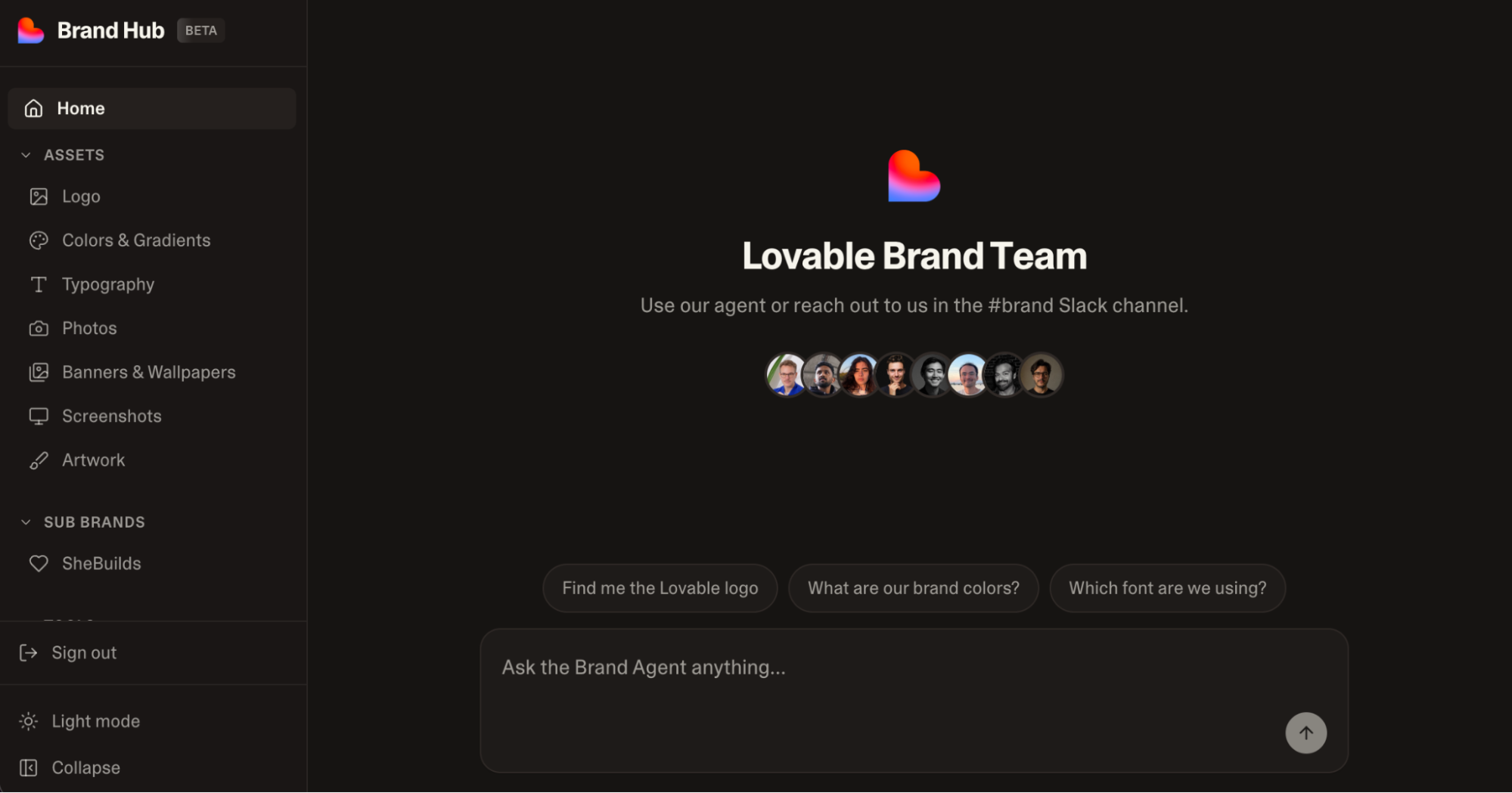
Felix Haas, one of Lovable’s earliest designers, built Brand Hub to solve both problems. Instead of another static wiki, Brand Hub gives teams gated access to approved logos, color palettes, typography, and voice rules. Anyone can export logos in custom aspect ratios, generate branded LinkedIn banners, download press photos, and format email signatures in seconds.
Brand Hub turns guidelines into functional software. Anyone can produce on-brand collateral in two minutes, and our
core visual identity stays protected.
Felix Haas, Brand & Design
The hub also has a built-in agent that teammates can chat with to edit slide decks, blog posts, and campaign copy to match Lovable’s voice. Through the Lovable MCP, teams can even pull approved brand rules and assets straight into Claude, ChatGPT, or another AI assistant.
For brand designer Abey Thomas, automating routine asset formatting keeps the focus squarely on high-impact creative work.
“The agent in Brand Hub is unlike anything I have seen at other companies. When someone needs a specific logo in an unusual format, they just ask the Hub instead of tapping a designer,” says Abey. “Having self-serve tools for things like social banners and signatures takes a massive amount of repetitive work off our plate.”
Turning brand standards into software the whole company can run on
By building their own operating system, Lovable’s design team turned their taste and standards directly into software. Custom apps now handle request triage, workload balancing, and self-serve asset creation across every department. Now that the designers don’t have to chase down missing context and manually export logo files, they can stay focused on what they do best: building an unmistakable brand.
“Designers and creatives should spend their time obsessing over solving problems, doing great work, and pushing their craft forward—not passing tickets back and forth,” said Nad. “Putting our standards into software means the brand stays consistent everywhere, and we get to stay focused on creative expression and the heart of our brand.”

 Nad ChishtieHead of Design
 Carly OldCreative Production
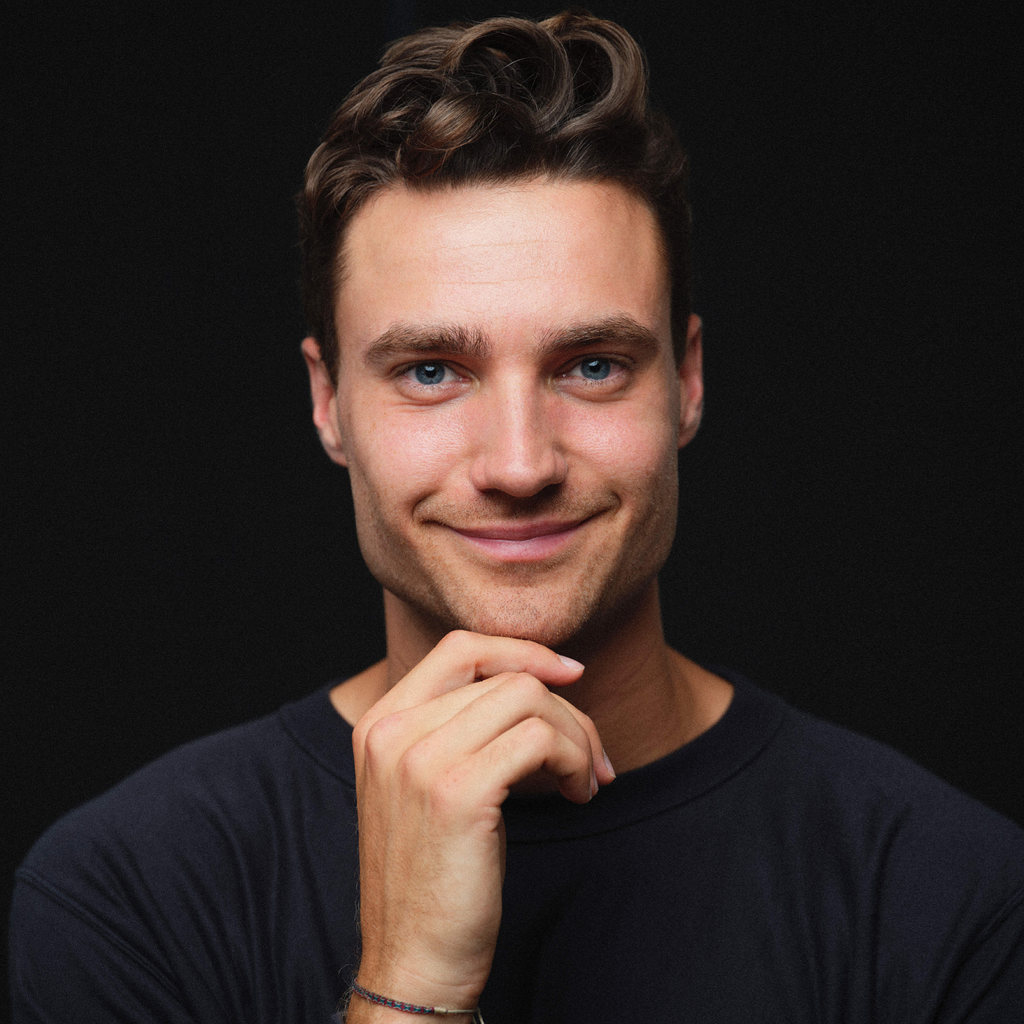 Felix HaasBrand & Design
 Abey ThomasBrand Designer