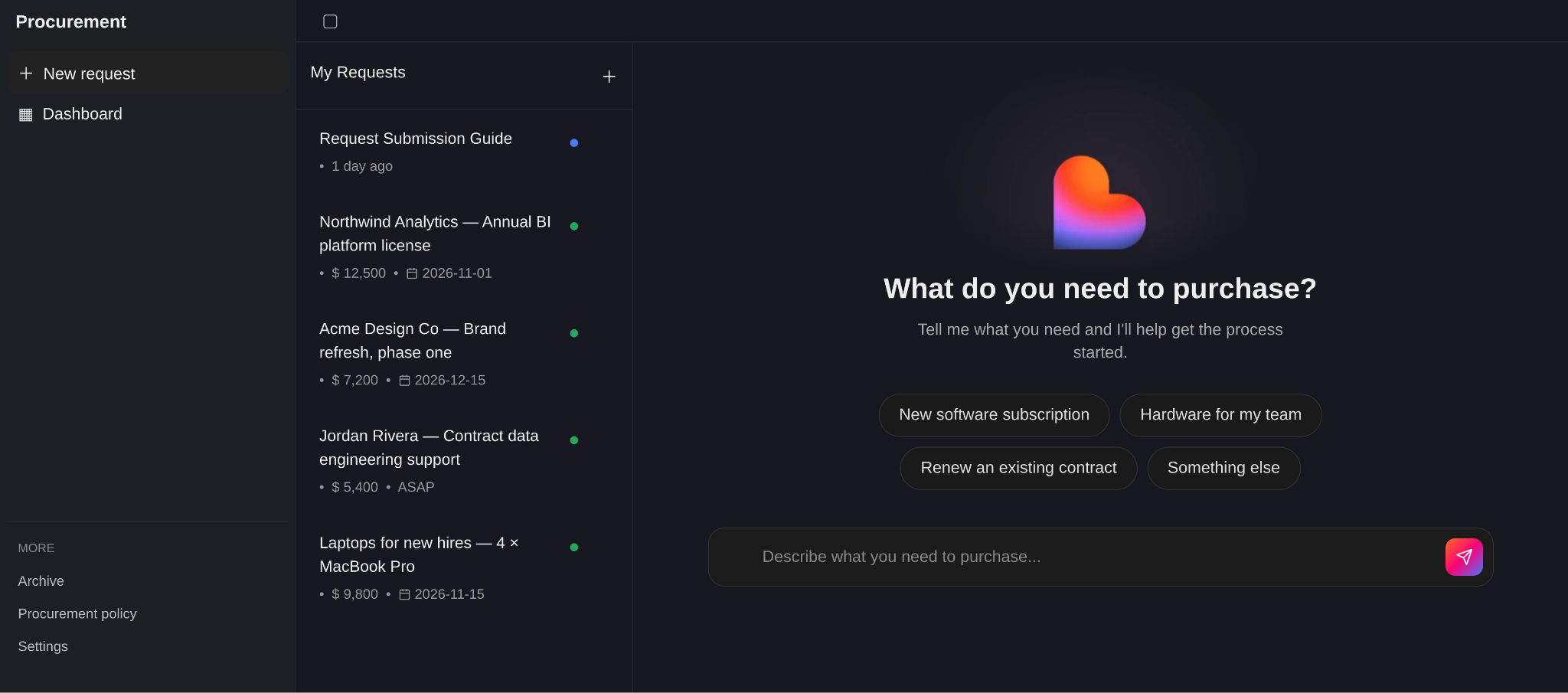
Procurement automation eliminates $60,000 in platform costs and hundreds of review hours. Lovable’s procurement app uses automated policy agents to complete pre-purchase diligence across software, contractor, and agency spend, speeding up approvals while giving finance real-time visibility into committed spend.
Automated invoicing cuts 130 hours of manual reconciliation quarterly. By connecting the general ledger directly to the CRM, the finance team stages invoices, tracks aging receivables, and resolves billing disputes without spreadsheet handoffs.
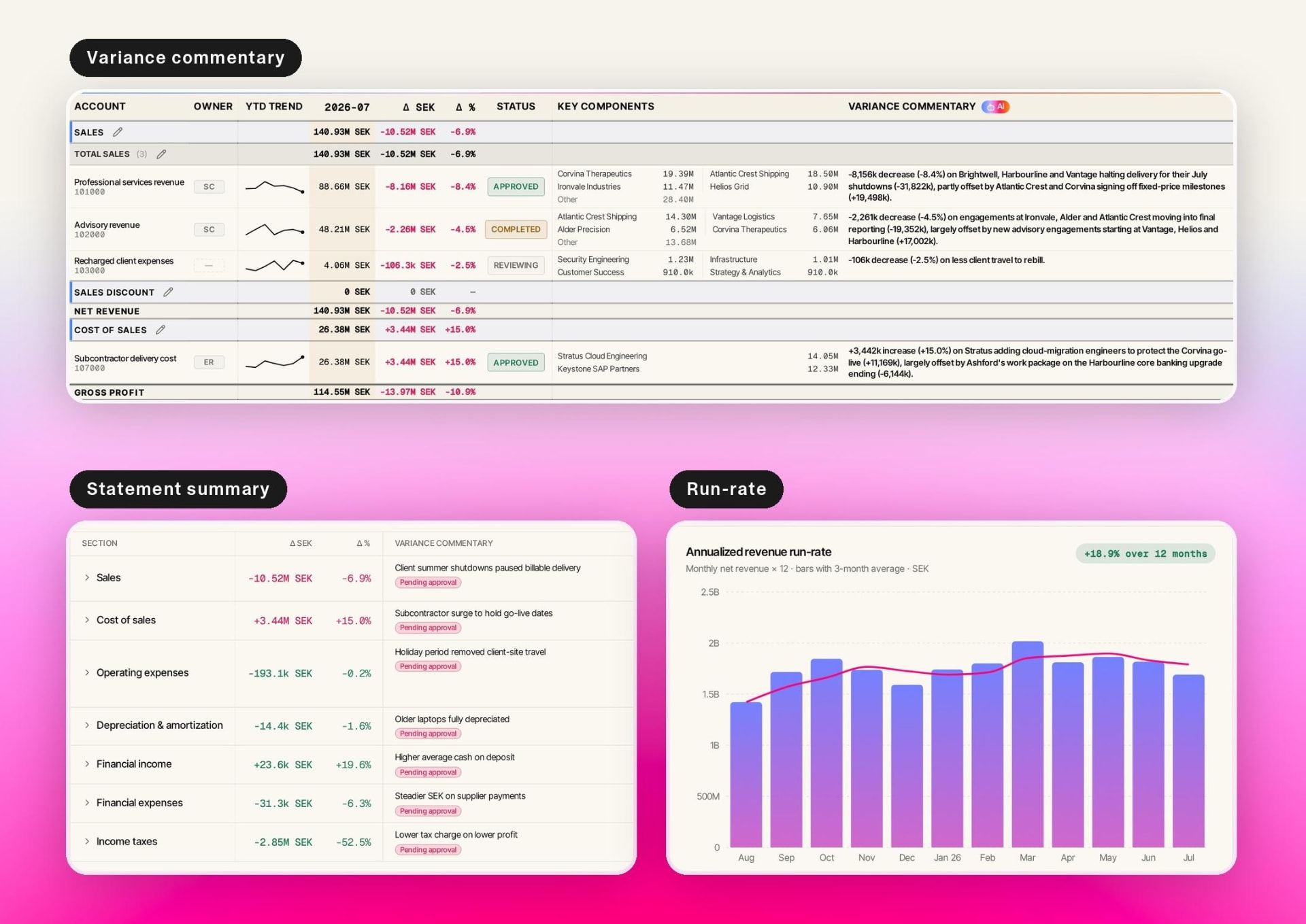
Automated variance analysis replaces an eight-day month-end close scramble. By pairing ledger balance shifts with context from Slack, Gmail, and meeting notes, an internal tool lets a single person explain and audit financial fluctuations in minutes.
Custom board meeting software turns static presentations into focused strategy discussions. An interactive board app organizes pre-read materials and recorded walk-throughs before meetings, then guides live discussion and question triage so leadership and the board focus on strategic decisions.
Typically, a company’s financial data is trapped across disconnected tools and spreadsheets, leaving finance teams assembling history instead of steering the business.
But when a company moves as fast as Lovable, the finance team can’t wait weeks for month-end reports. Instead of waiting on closing cycles, Lovable’s finance team builds its own software. By connecting live systems directly, the team is able to review spend before commitments are signed, track incoming cash as terms come due, and spot balance shifts in real time.
Finance can’t just look backward once a month. We need live visibility. Building our own tools with Lovable gives us a
live view of spend, commitments, and overall performance while there’s still time to act.
Andy Toung, Chief Financial Officer
Here’s how Lovable’s finance team handles procurement, cash flow, financial reporting, and board strategy by building their own software.
Governing procurement without slowing business
Fast-growing teams need tools, contractors, and services to move quickly. In traditional organizations, procurement is slowed down by intake forms, vendor questionnaires, and scattered sign-offs.
To solve for the lag, Harald Johansson and Ludvig Widmark, members of the Finance and Business Operations team at Lovable, built an internal procurement app that turns a friction-heavy process into a seamless conversational workflow.
Instead of filling out dozens of fields or paperwork, team members simply tell the chatbot what they need — like software, contractors, or agency work — and it fills out the procurement fields for them. Behind the scenes, automated review agents evaluate the request against compliance, legal, security, IT, and finance rules, routing approvals to the right stakeholders and maintaining an auditable activity log.
The app also pushes employees to build before they buy. Whenever someone requests a new software tool, the app asks: “Have you tried building this with Lovable instead?” That single prompt has eliminated redundant subscriptions and turned procurement into an engine for building internally.
To date, the procurement app has processed over 400 requests, avoided a $60,000/year vendor platform, and saved hundreds of hours of manual review time across teams.
Procurement shouldn’t feel like a black box. Our procurement app gives the entire company one place to start so
requesters don’t have to guess who needs to be involved or how to loop them in. The system coordinates Legal,
Security, IT, and Finance team reviews automatically. It gives us a clean audit trail, an organized vendor list, and
full visibility into what we’re buying and who we’re buying from.
Harald Johansson, Finance and Business Operations
Accelerating enterprise accounts receivable
Reviewing spend upfront keeps commitments under control, but rapid enterprise customer growth creates an equally urgent challenge. If an invoice misses its billing date or an overdue balance is not caught immediately, incoming cash lags behind revenue recognition. Managing payment terms and staggered invoicing deadlines between the CRM, ERP, and spreadsheets is a recipe for delayed collections.
To keep cash moving, Sam Jung, who runs Lovable’s Deal Desk, built an enterprise accounts receivable app. The tool connects directly to the company’s ERP, CRM, and shared billing email inbox to automate the entire receivables workflow from the moment a contract is signed. It tracks invoices for each account, automates follow-ups on overdue invoices, and escalates issues in appropriate channels. The app also dynamically learns what works for each customer, such as the average time to pay, or flagging if an invoice contact needs to be updated.
Now, collections stay predictable, saving the finance team roughly 130 hours of manual admin work every quarter. After rolling out the app, past-due balances dropped by 14%, even as total open receivables surged by more than 3X.
“When enterprise deals move this fast with a lean team, manual billing means you’re always reacting after an invoice is already late,” says Sam. “Now, collections happen on time, customers get clear invoices matching their agreed terms, and our team doesn’t spend hours chasing customers to pay overdue invoices.”
Automating month-end variance analysis across three global entities
Even with purchases approved upfront, financial forecasts rarely match actual costs down to the dollar: Cloud infrastructure scales with demand, contractors hit milestones early, and software costs change as teams grow.
The general ledger tells accountants what changed, but not why. Accountants are left playing detective, digging through Slack threads, tickets, contracts, and disconnected spreadsheets to discern the operational cause before closing the books.
To save Lovable’s accountants from scrambling last minute to find explanations for variances each month-end, Erik Petersen and Rachel Hamilton Ek from the Accounting & Finance team built a variance analysis app that brings financial data, business context, and accounting controls into one workflow.
The app connects the general ledger directly with Lovable’s data warehouse and the team’s shared context, pulling together emails, messages, meeting notes, and internal finance apps for taxes, payroll, and accruals. Across Lovable’s Swedish, U.S., and U.K. entities, the app identifies account movements, retrieves supporting context without exposing sensitive employee information, and drafts commentary using accounting-specific rules. Every figure comes directly from the general ledger, traces back to the underlying transaction, and includes timestamped reviews for a complete audit trail.
What previously took multiple accountants eight days can now be analyzed in minutes by one person, with stronger controls and deeper context.
“Closing used to mean days of cleaning data, reconciling numbers, and figuring out what changed, leaving barely any time to understand why,” says Erik. “Now, the manual work is handled automatically so I can focus on the business. But the best part is that we built this ourselves. There’s real pride in building tools that make your own work better — it brings a whole new level of energy to accounting.”
Flipping board meetings from passive presentations to active strategy
With spend managed, receivables flowing, and the monthly close down to minutes, the finance team has the live data needed to steer the business. But communicating that progress to the board traditionally means weeks of compiling slide decks — only to spend the meeting talking at board members instead of debating strategy.
To run more productive 90-minute meetings, CFO Andy Toung built a custom board management app.
Executive updates and video walk-throughs are organized for board members to review and submit questions ahead of time. During the meeting, the app anchors the agenda around key topics, sparks live discussion with polls, pulls up data when needed, and sorts questions on screen. In the final minutes, the app synthesizes written reflections from attendees into clear takeaways.
A board meeting should never be an executive team reading 80 slides to a room that skimmed them on the way in. Moving
updates to asynchronous video and pre-reads changes the dynamic completely. We don’t burn 90 minutes presenting the
past. We spend the time stress-testing our strategy, addressing the hardest questions, and walking away aligned on
what comes next.
Andy Toung, Chief Financial Officer
Scaling finance at the speed of software
Finance teams often face an unnecessary tradeoff: Slow the business down with rigid approvals, or lose visibility into spend, collections, and performance.
By building custom software tailored to its exact workflows, Lovable’s finance team created a model for modern financial operations. Spend is governed quickly and proactively, enterprise cash flow is accelerated automatically, and leadership steers the business with live numbers.
It’s proof that when finance teams stop chasing receipts and stitching spreadsheets together, they can get back to guiding company strategy and scaling capital efficiently.

 Andy ToungChief Financial Officer
 Harald JohanssonFinance and Business Operations
 Ludvig WidmarkFinance and Business Operations
 Sam JungDeal Desk
 Erik PetersenAccountant
 Rachel Hamilton EkAccounting Controller